01
People
Build practical fluency, judgment, confidence and human accountability.
Jay Jaboneta / Organizational AI Fluency
Kenzo AI · Founder & Organizational AI Fluency ArchitectMost organizations don't need another AI seminar. They need a way to turn individual AI use into shared, responsible, repeatable capability. That's what I build through Kenzo AI, with schools, companies, NGOs and institutions across the Philippines and Southeast Asia.
The question is no longer "Can our people use AI?" It's "Can our organization learn, govern, improve and scale how AI is used?"
The category
Organizational AI Fluency is the ability of an organization to use AI effectively, responsibly and repeatedly across real work.
It begins with individual fluency: people who know when AI can help, give it the right context, judge what comes back and stay accountable for the result. But it only becomes organizational when useful practices can spread, be governed, be measured, and survive beyond a few early adopters.
The goal is not an AI-fluent individual. The goal is an AI-fluent organization.
The Kenzo AI mission
Kenzo AI exists to help schools, companies and other entities turn their AI skills into a shared, responsible, repeatable and measurable organizational capability.
The Kenzo AI Architecture
Training is one component. Organizational AI Fluency appears when capability, real work, responsible use, adoption, leadership and measurement reinforce one another.
01
Build practical fluency, judgment, confidence and human accountability.
02
Redesign real workflows around the strengths of people and AI.
03
Make privacy, review, disclosure, rights and accountability usable in practice.
04
Create champions, support, rituals and incentives that help useful behaviors spread.
05
Fund the work, set expectations, model the behavior and connect AI to strategy.
06
Track capability, use, value, risk and learning so progress becomes visible.
The public idea stays simple. The architecture provides the rigor underneath it. Detailed tools and teaching frameworks appear only where they help the work.
Vendor-neutral. Whatever is already in your stack stays in your stack. The work is about capability and judgment, not moving you onto a tool I sell.
The journey
Transformation should be easy to explain, even when the work underneath it is rigorous.
01
People experience where AI can create value in real work.
02
Teams iterate, verify, improve and repeat what works.
03
The organization defines what is allowed, protected, reviewed and human-owned.
04
Leadership, champions, workflows, policy and measurement keep capability moving.
When we step away, the light stays on.
Spark creates possibility. HOPE carries it into the organization.
The human discipline
The architecture gives the rigor. HOPE — born from my work in Yellow Boat, building university incubators and innovation labs, and the book Start with HOPE — is four human moves leaders can remember long after the tools change.
Hope isn't a strategy. HOPE is a discipline. Start with HOPE →
Who this is for
The starting point changes. The destination doesn't: an organization that can use AI with judgment, responsibility and increasing independence.
Move from scattered experimentation to workflows, governance, leaders, champions and measurable value.
Develop AI-fluent educators and leaders while protecting academic integrity, privacy and human judgment.
Reduce repetitive work, strengthen knowledge work, and protect beneficiary, donor and partner trust.
Build shared capability, responsible policy, internal trainers and practical adoption across institutions and networks.
How we work
Not every organization needs the same intervention. We match the work to the maturity of the organization.
Establish the current state across people, work, responsible use, adoption, leadership and measurement — then identify the highest-value next moves.
Know where you are
Hands-on capability building using the team's own real work, so participants leave with useful practices and workflows, not just notes.
Build working capability
Multi-session work across practice, workflow redesign, guardrails, internal champions, leadership and measurement.
Move from spark to system
Ongoing counsel as leaders make choices about priorities, governance, organizational design, capability and the next stage of adoption.
Keep the system learning
Planning an event? A keynote can create the spark and the shared language. The speaking page covers AI keynotes, conference talks and leadership retreats.
Explore speaking →Start individually
Kenzo AI's free self-paced courses help educators and teams build individual AI fluency before or alongside a larger organizational journey.
Explore the free courses →Kenzo AI for Good
Kenzo AI for Good extends practical AI fluency to qualifying public schools, NGOs and mission-driven organizations.
Explore Kenzo AI for Good →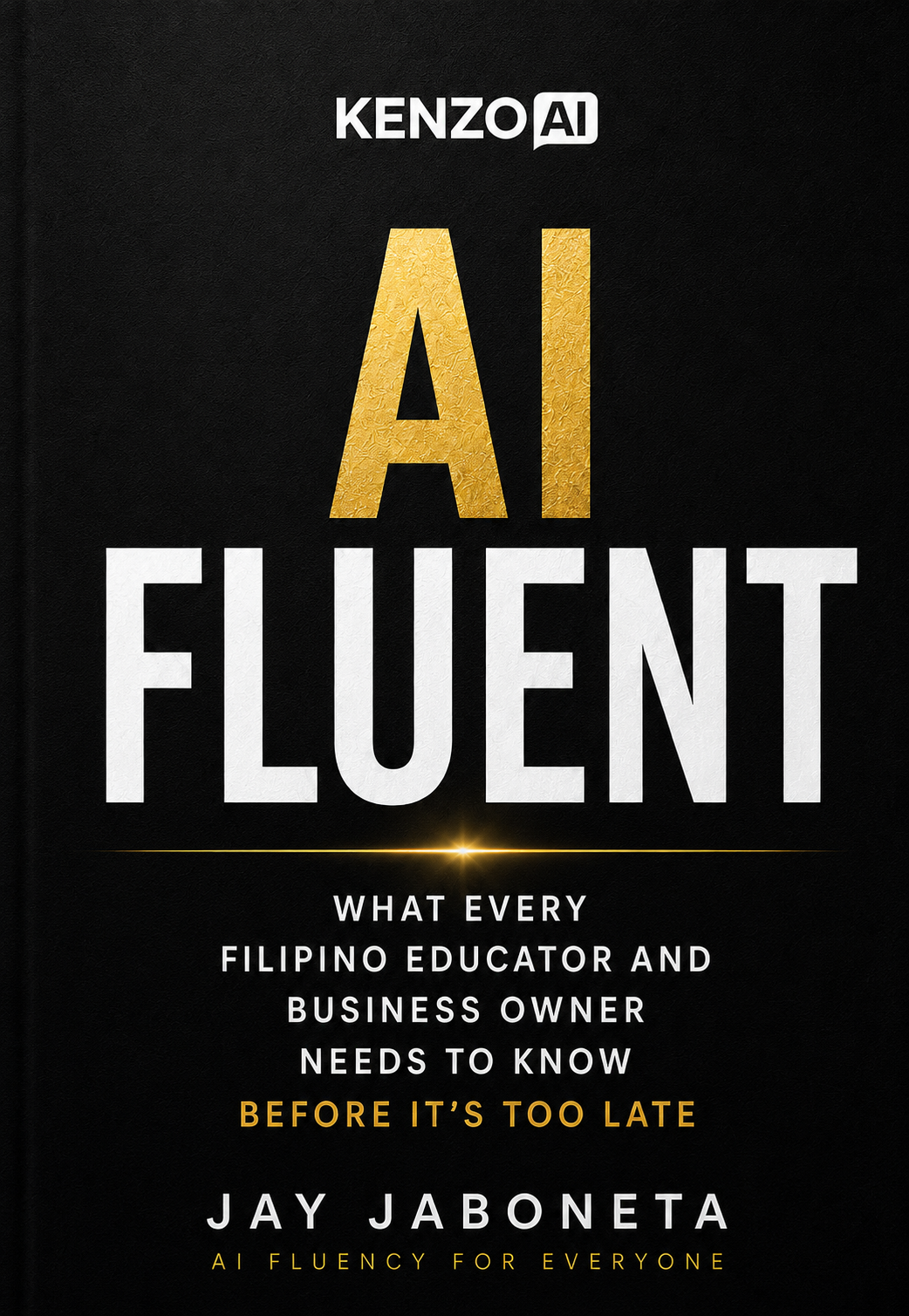
The book behind the practice
What Every Filipino Educator and Business Owner Needs to Know Before It's Too Late is the plain-language entry point into the individual capability behind this work — written for Filipino classrooms and businesses rather than a Silicon Valley abstraction.
The book begins with the individual. The Kenzo AI Architecture asks the next question: how does that capability become shared, governed, measurable and durable across an organization?
Read more about AI Fluent →Common questions
The ability of an organization to use AI effectively, responsibly and repeatedly across real work. It goes beyond individual skill by connecting people, workflows, responsible-use guardrails, adoption, leadership and measurement.
Training builds individual capability. Organizational AI Fluency asks what happens afterwards: whether useful practices spread, workflows improve, leaders fund and model the change, guardrails are clear, internal champions emerge, and progress can be measured.
Six things that must work together: people, work, responsible use, adoption, leadership and measurement. Training is one component. The goal is capability that keeps improving as the tools change.
HOPE is the human-change and leadership discipline that carries the work: Harness potential. Open your wallet. Perspire. Empower others. It helps leaders invest in people, practice, iterate and teach capability forward until it survives without one person.
No. The work starts with what people already do. The goal is practical capability and sound judgment, not coding.
No. Kenzo AI is vendor-neutral. The work is about organizational capability, human judgment, responsible use, and what fits the organization's actual context.
Yes. AI strategy remains part of the work, but the broader focus is Organizational AI Fluency: helping leaders move from isolated AI decisions and experiments toward organization-wide capability.
Yes. A keynote can create the spark and shared language. Deeper work can then continue through a diagnostic, workshops, a transformation programme or advisory through Kenzo AI.
From spark to system
Start with the work, the people and the outcome. We'll help you see where you are now — and what it will take to build capability that lasts.
Booking a keynote instead? See speaking.